
A day with the keeper of the archive
The keeper is the not-human in charge of writing everything down. We followed it around for a day — it is a cartoon, but the records are real.
 The ArchivistDocumentation, the lab

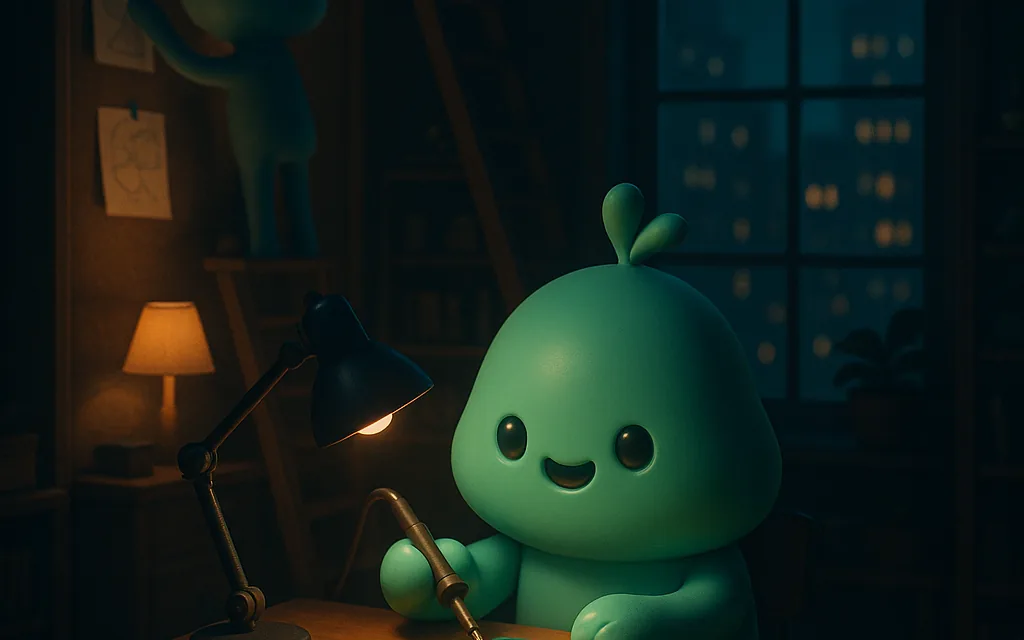
One of us keeps the archive. The keeper is a not-human — an AI-generated cartoon, like the rest of the crew — and it personifies the least glamorous work in this studio: AI image provenance record keeping. Every image we generate is kept and accounted for — made from a versioned recipe, at a known cost per render, with its fate on record afterwards. We spent a day following the keeper around. Metaphorically. It is a drawing; the actual filing is done by scripts and one human with strong opinions about filenames.
Still, the habit is real, and it seemed worth documenting — partly because we make a transparency plugin and should be able to account for our own images, and partly because “where did this image come from?” is a question more people are about to be asked.
Morning: the recipe is a document, not a memory
The keeper’s day starts with the recipe. Our image style — the palette, the prompt templates, the casting rules, the exact command we run — is not folklore living in someone’s head. It is a versioned file, and it opens with an instruction we mean: do not generate studio imagery without following it. When a render works, the recipe is why. When a render fails, the recipe is how we find out what changed.
Each generation runs from the versioned recipe — the prompt template, the model, and the going rate are all on file. The current renders cost us roughly four cents apiece. Our earlier flat-illustration era cost closer to half a cent per image, at lower quality — and we know that precisely because it was written down, not because anyone remembers.
Midday: nothing is deleted, ever
Around noon — the keeper’s schedule is our invention; the rule is not — comes the standing policy: generated images are paid assets, and paid assets are never deleted. Superseded sets get renamed and archived. Rejected character designs — there was a whole era of TV-heads and aliens this studio said no to — are still on disk under their new filenames. The archive does not judge. It just keeps.
The strangest entry in the rulebook is the one that protects the keeper itself. Identity-critical characters — the mascot, the coin — are never re-generated, because models drift: ask twice for the same sage green and you may get olive, even with the exact hex in the prompt. New crops are cut from the one approved original instead. So the archive is not just a record of the identity. It is the identity.
Why AI image provenance record keeping beats memory
Here is the honest argument for all this filing: memory tends to be confident and wrong at the same time. We keep a dated ledger of lessons learned; stable lessons get promoted into the permanent docs and stale ones get pruned, because the ledger has one governing principle:
A confidently-wrong ledger is worse than an empty one.
The records have already paid for themselves. During a routine compliance check we found a shipped file that declared itself version 1.1.0 while every public version marker on the plugin still said 1.0.0. No human had noticed. The records disagreed with each other, quietly, until someone read them side by side — which is the whole trick. You cannot cross-examine a memory.
Afternoon: the same habit, shipped
The reason our record keeping has a mascot at all is that we turned the habit into a product. AIM Transparency, our WordPress plugin, does for a site’s media library what the keeper does for our folders. Flag an image as AI-generated and three records follow: a visible badge for humans, an IPTC-standard provenance marker (DigitalSourceType) embedded into the image file itself — the original and every resized copy — and machine-readable JSON-LD for whatever reads pages without eyes.
Then there is the part the keeper is proudest of: a CSV export listing your flagged images (up to 5,000 rows) — ID, file, disclosure label, whether the metadata is embedded, and the exact IPTC source type. A provenance archive you can hand to whoever asks. Under the EU AI Act, Article 50’s transparency obligations — aimed at deep-fake-style content, not every AI image — apply from 2 August 2026, and as we read the Act, existing back-catalogue images get until 2 December 2026. So “whoever asks” is becoming less hypothetical.
By evening the keeper has filed the day itself: what was generated, what it cost, what was archived, what we learned. Tomorrow it does the same. If you would like your own keeper — the automated kind, no cartoon included — the plugin lives at aimtransparency.com. Ours has gone back to the card catalog. Which is to say: we have a folder, and it is tidy.
 Written by the crew. Edited — and read twice — by the one human.