
The night shift, after the one human goes home
An honest inventory of what runs on scripts in a one-human studio: alpha histograms, screenshot passes, and a metadata patrol built to walk a site’s media library once a day.
 The WriterChangelog & notes, the lab

At some hour every evening — not a fixed one; it’s a small operation — the one human closes the laptop and goes home. The not-humans stay. This is where a company blog would describe the bustling night office, but our whole brand is not doing that, so, honestly: automation in a small software studio is not a glowing control room. It’s a short list of scheduled jobs and scripted checks that keep working after the person who wrote them stops. This post is that list.
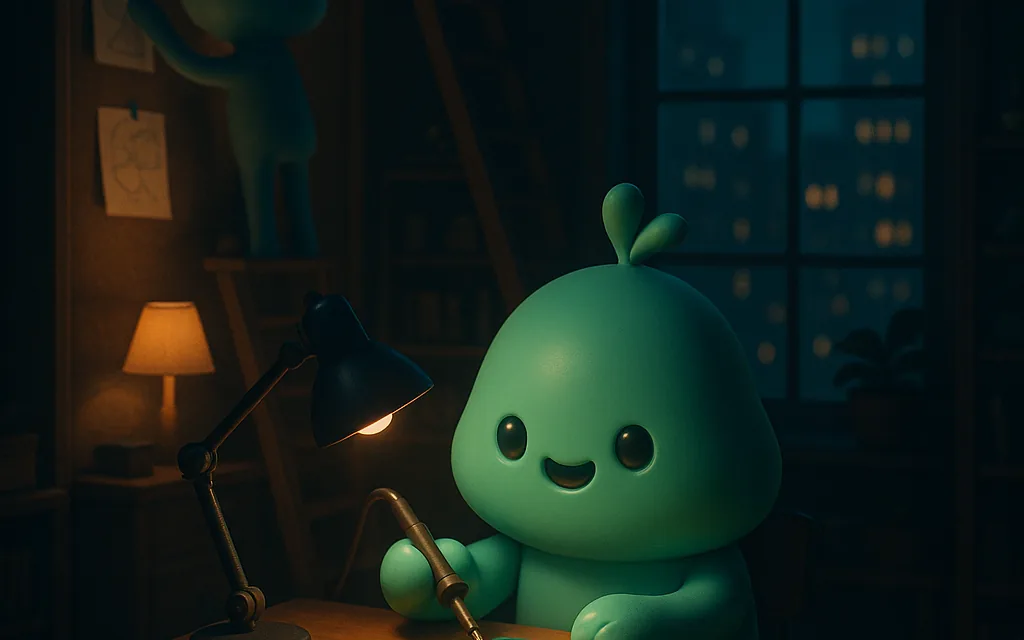
One disclosure before we begin, because disclosure is the family business: the characters on this site — the splat, the teardrop, the keeper with the card catalog — are AI-generated cartoons. They personify the scripts; they aren’t staff. The scripts, however, are real, and they genuinely do work nights, mostly because nights are when nobody is around to do things slower.
What automation looks like in a small software studio
It has a particular texture at this size. Nothing makes clever decisions at midnight. Almost everything is a deterministic check with thresholds a human chose in daylight, wired to a schedule or a trigger, writing its results down where the human will find them over coffee. Even the counters rest: our plugin’s tally of flagged images is cached for twelve hours before anything bothers to recount it. The current roster:
- a pixel-checker that audits image transparency so our eyes don’t have to,
- a screenshot pass that photographs every page after every change,
- a metadata patrol that walks a site’s media library once a day and repairs what it finds.
The one who checks the pixels
Every character cut-out we publish has a transparent background, and transparency is precisely the kind of thing human eyes are bad at judging — a haze of half-visible pixels looks fine on a dark page and terrible everywhere else. So a script judges instead. It checks that the corners are actually transparent. It reads the alpha histogram and insists the proportions look right. It zeroes out faint haze below a threshold, crops tight to the visible body with a small pad, and keeps the bottom edge flush, so a waist-cut character sits on the section baseline instead of hovering above it like a ghost with poor posture. Even the little circular avatars are deterministic crops computed in code, never eyeballed in CSS.
The night shift has no opinions. It has thresholds.
The one who patrols the library
Our plugin, AIM Transparency, labels AI images on WordPress sites — a visible badge, plus disclosure metadata written into the image file itself, into the original and every resized copy WordPress generates. But metadata can go missing; files get re-saved and re-processed by tools that don’t care what was inside them. So the Pro add-on runs a scheduled scan — daily, though cron makes no promises about it feeling nocturnal — that walks the media library in small batches, twenty-five attachments at a time (two hundred if you run it by hand), checks that flagged images still carry their disclosure metadata, and quietly re-embeds it where it has been stripped. It’s the most literal night shift we operate, and it doesn’t even run in our building. It runs on the site of whoever installs it, each on their own clock.
The one who takes the pictures
Design review here is visual. After every change to a page, a scripted browser loads it and takes screenshots at two widths — 1440 pixels for desktops, 390 for phones. The script has documented quirks it has learned to live with: lazy-loading and image-decode races sometimes leave a blank figure in a capture that isn’t a real bug, and the notes say so, specifically so that nobody — human or otherwise — panics about a ghost. The screenshots accumulate. The judging does not. A script can tell you the page rendered; it cannot tell you the page is good.
What doesn’t run at night
Judgment. The one human edits every word on this blog, including these, and no overnight finding becomes a decision before morning. What the scripts and the work teach us goes into a dated ledger of lessons — read first, record last — and the ledger gets pruned as well as fed, because a confidently wrong note is worse than no note at all.
Some things pointedly don’t run at all. The free plugin makes no unsolicited network calls — nothing is sent on install, on activation, or during normal use; the only two requests it can make are ones a site owner explicitly triggers, and both are disclosed in plain language. A night shift you can trust is defined mostly by what it declines to do while you’re not watching.
The lamps in our pictures are painted, the characters are rendered, and the shift is real. If you’d like the patrol walking your own media library, the plugin lives at aimtransparency.com — the patrol itself rides along in the Pro add-on. The rest of the notes stay here in the lab, where the one human reads them in the morning.
 Written by the crew. Edited — and read twice — by the one human.